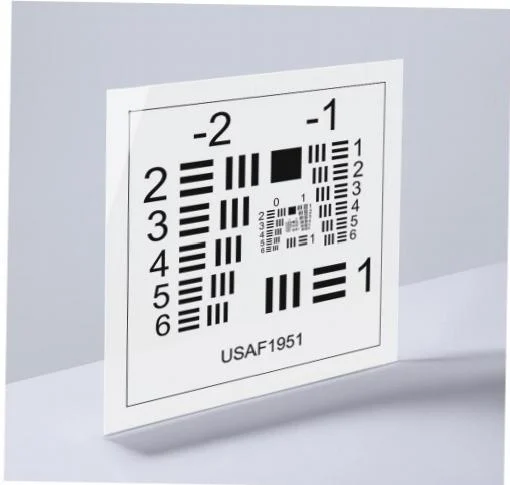
USAF 1951 resolution test target
A standard bar-group pattern helps evaluate the resolving power of lenses, microscopes, and imaging equipment for fine detail.

USAF 1951 resolution targets
USAF 1951 resolution targets for lenses, microscopes, automotive cameras, and industrial imaging systems. Transmissive or reflective formats can be confirmed by size, substrate, illumination, and reading method.
Start from the use case
USAF 1951 uses standard bar groups and elements to show the fine detail an imaging system can resolve. Selection follows the lens, working distance, illumination, test distance, and reading method rather than the chart name alone.
Request a quotePublished product directions
The product links below provide a concrete reference for the solution. Pattern, substrate, dimensions, accuracy, and delivery are confirmed per project.
A standard bar-group pattern helps evaluate the resolving power of lenses, microscopes, and imaging equipment for fine detail.
Before you ask
A complete input list helps engineering review the plan quickly. Send what you already have; missing details can be confirmed during the enquiry.
Technical confirmation
Clarify whether the target compares lens resolution, checks a system limit, or supports incoming and outgoing inspection.
Match the optical mode to the light source, lens structure, and how the target is used on site.
Use the smallest line width and test distance to set the pattern range, chart size, and substrate.
Record visual inspection, capture, software analysis, packaging, and delivery requirements in one confirmation sheet.
FAQ
No. The group range should cover the useful resolving range and leave room for comparison. A pattern that is too fine may exceed the lens, distance, or lighting conditions.
They can be assessed against the equipment and illumination. The optical mode changes substrate, contrast, and handling requirements, so it is fixed before plate making.
It can support resolving-power and detail comparisons. Magnification, working distance, illumination, and reading method still need to match the microscope model.
Pattern version, dimensions, optical mode, accuracy, and delivery parameters are governed by the technical confirmation sheet.
We will confirm a workable plan based on the pattern, substrate, accuracy, and operating environment. All parameters are subject to the final technical confirmation sheet.
Analytics choice
Allow Google Analytics and Baidu Analytics to measure visits and improve the inquiry journey. Rejecting does not affect site features. Privacy policy